
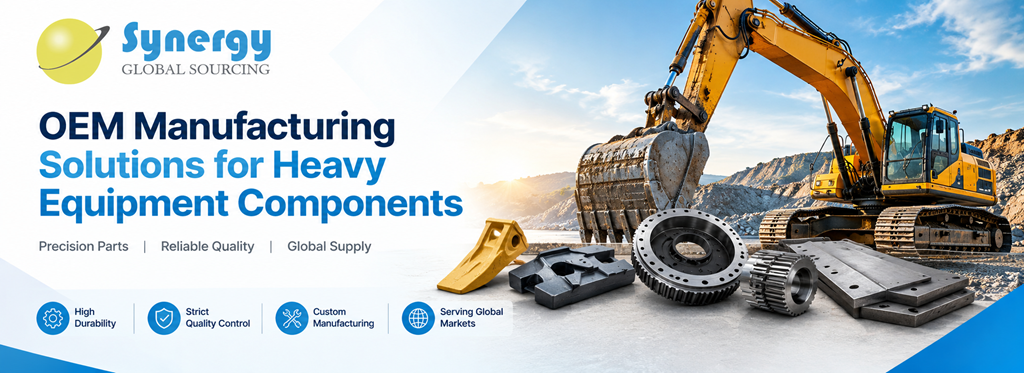
Heavy equipment manufacturers require components that can withstand demanding operating conditions, high mechanical loads, vibration, impact, abrasion, and continuous use. From construction and mining machinery to material-handling and industrial equipment, every component must meet precise engineering and performance requirements.
OEM manufacturing solutions for heavy equipment components help equipment manufacturers source custom parts and assemblies according to their drawings, specifications, materials, tolerances, and production requirements.
Synergy Global Sourcing provides OEM manufacturing and global sourcing solutions for heavy equipment components, supporting customers with custom metal parts, fabricated components, machined parts, castings, forgings, welded assemblies, and other engineered components.
What Are OEM Manufacturing Solutions for Heavy Equipment Components?
OEM manufacturing refers to the production of components according to the original equipment manufacturer’s engineering requirements.
Instead of purchasing generic replacement parts, OEM customers can work with a manufacturing partner to produce components designed specifically for their equipment.
An OEM manufacturing program may include:
- Engineering drawing review
- Material sourcing
- Prototype development
- Custom component manufacturing
- Fabrication
- CNC machining
- Metal casting
- Forging
- Welding
- Heat treatment
- Surface finishing
- Quality inspection
- Assembly
- Packaging
- Global logistics
The exact manufacturing process depends on the component design, material, application, quantity, tolerances, and required performance.
Why OEM Manufacturing Is Important for Heavy Equipment
Heavy equipment operates under significantly different conditions from many standard industrial applications.
Components may be exposed to:
- Heavy mechanical loads
- Shock and impact
- Continuous vibration
- Abrasive materials
- Dust and dirt
- Moisture
- Temperature variations
- Repetitive loading
- Corrosive environments
For this reason, component manufacturing needs to be aligned with the equipment’s engineering requirements.
OEM manufacturing allows equipment manufacturers to maintain greater control over component specifications, materials, dimensions, tolerances, and quality requirements.
Heavy Equipment Components That Can Be OEM Manufactured
OEM manufacturing can cover a wide range of components used in heavy machinery.
Common examples include:
Structural Components
Structural components provide support and stability to heavy equipment.
These can include:
- Frames
- Mounting structures
- Support brackets
- Reinforcement plates
- Structural assemblies
- Chassis components
- Equipment supports
Wear Components
Heavy equipment frequently operates in abrasive environments.
Wear-related components may include:
- Wear plates
- Wear liners
- Cutting edges
- Impact components
- Abrasion-resistant parts
- Protective components
Material and manufacturing methods should be selected according to the specific operating conditions.
Machined Components
Precision-machined components may be required where accurate dimensions and interfaces are important.
Examples include:
- Shafts
- Bushings
- Pins
- Housings
- Flanges
- Spacers
- Mounting components
- Precision mechanical parts
Cast Components
Metal casting can be suitable for complex heavy equipment components where component geometry, strength, material requirements, and production volume make casting appropriate.
Cast components may include:
- Housings
- Brackets
- Structural parts
- Machine components
- Heavy-duty industrial parts
Forged Components
Forging can be used for components that require specific mechanical properties and high structural integrity.
Depending on the application, forged components may include:
- Shafts
- Pins
- Levers
- Structural parts
- High-load mechanical components
Welded Assemblies
Welded fabrication is commonly used for larger heavy equipment structures.
Applications include:
- Frames
- Mounting assemblies
- Structural supports
- Equipment guards
- Brackets
- Heavy fabricated structures
OEM Manufacturing Processes for Heavy Equipment Components
A complete OEM manufacturing solution can combine multiple production processes.
CNC Machining
CNC machining is used when components require controlled dimensions, precise interfaces, holes, threads, bores, or finished surfaces.
Machining can be performed on components made through different primary manufacturing processes, depending on the design.
Metal Fabrication
Metal fabrication can produce structural components, brackets, frames, panels, guards, and other fabricated parts.
Typical processes include:
- Laser cutting
- Plasma cutting
- CNC bending
- Forming
- Welding
- Drilling
- Assembly
Metal Casting
Casting allows manufacturers to produce components with complex geometries that may be difficult or inefficient to manufacture through conventional machining or fabrication.
The selection of a casting process depends on material, geometry, component size, production volume, dimensional requirements, and application.
Forging
Forging uses controlled deformation to produce components with specific mechanical characteristics.
It can be considered for heavy-duty components subjected to significant mechanical loads.
Heat Treatment
Certain components may require heat treatment to achieve desired hardness, strength, toughness, or wear characteristics.
Heat treatment requirements depend on the material and component application.
Surface Treatment and Finishing
Surface finishing can improve corrosion resistance, wear performance, appearance, or other application-specific characteristics.
Depending on requirements, processes may include:
- Painting
- Powder coating
- Plating
- Galvanizing
- Protective coatings
- Surface hardening
- Deburring
Industries That Use OEM Heavy Equipment Components
OEM-manufactured components are used across several heavy equipment sectors.
Construction Equipment
Construction machinery requires components capable of handling heavy loads, vibration, impact, and challenging job-site conditions.
Applications can include structural components, brackets, fabricated assemblies, machined parts, wear components, and mounting structures.
Mining Equipment
Mining equipment operates in particularly demanding environments where components may experience high loads and severe abrasion.
OEM manufacturing can support components such as:
- Wear-resistant parts
- Structural components
- Crusher-related components
- Mounting parts
- Heavy fabricated assemblies
- Machined components
Material Handling Equipment
Material-handling machinery requires components that support repeated movement and mechanical loading.
Fabricated structures, shafts, brackets, housings, supports, and machined parts may be manufactured according to OEM specifications.
Industrial Equipment
Industrial machinery often requires specialized components designed around specific equipment configurations.
OEM manufacturing can support both standard production parts and custom-engineered components.
Agricultural and Infrastructure Equipment
Large machinery used for agriculture and infrastructure applications may also require custom fabricated, machined, cast, forged, and welded components.
Custom OEM Component Manufacturing
Heavy equipment manufacturers frequently require components that are not available as standard off-the-shelf products.
Custom OEM manufacturing allows components to be produced according to:
- 2D engineering drawings
- 3D CAD models
- Technical specifications
- Material grades
- Dimensional tolerances
- Surface-finish requirements
- Heat-treatment specifications
- Inspection requirements
- Packaging specifications
This approach provides manufacturers with greater control over how components are produced and supplied.
From Prototype to Production
OEM component manufacturing often begins with a prototype or sample before moving into recurring production.
A typical workflow includes:
Engineering Review → Prototype → Inspection → Customer Approval → Production → Quality Control → Packaging → Shipment
Prototype production allows manufacturers to evaluate:
- Component dimensions
- Assembly fit
- Function
- Material selection
- Manufacturing feasibility
- Surface finish
- Tolerances
After approval, the manufacturing process can be standardized for repeat production.
Quality Control in OEM Heavy Equipment Manufacturing
Quality control is a critical part of OEM component manufacturing.
Heavy equipment manufacturers may require components to meet specific technical and inspection requirements.
Quality processes can include:
Incoming Material Inspection
Material documentation and identification can be reviewed according to project requirements.
Dimensional Inspection
Critical dimensions can be measured against approved engineering drawings.
Weld Inspection
Welded components can be inspected for workmanship and specified weld requirements.
Machining Inspection
Machined components can be checked for dimensions, tolerances, surface finish, holes, threads, and other critical features.
Surface Inspection
Finished components can be inspected for coating, paint, plating, or other surface-treatment requirements.
Final Inspection
The finished component can undergo final inspection before packaging and shipment.
Inspection requirements should be established according to the component’s engineering specifications and intended application.
Material Selection for Heavy Equipment Components
Material selection is one of the most important considerations in OEM component manufacturing.
Common material categories can include:
Carbon Steel
Carbon steel can be used for structural components, fabricated parts, brackets, frames, and other applications where strength and manufacturability are required.
Alloy Steel
Alloy steels may be selected for components requiring higher mechanical performance or specific combinations of strength and toughness.
Stainless Steel
Stainless steel can be considered where corrosion resistance is an important requirement.
Ductile Iron
Ductile iron can be suitable for selected cast components where strength, toughness, and castability are important.
Wear-Resistant Materials
Specialized wear-resistant materials may be considered for components exposed to abrasion and impact.
The correct material should always be determined according to engineering requirements rather than selecting material solely on cost.
How OEM Manufacturing Can Improve Supply Chain Efficiency
Working with an experienced OEM manufacturing and sourcing partner can simplify several stages of the component supply chain.
Instead of managing multiple independent suppliers for different processes, manufacturers may coordinate several requirements through a single sourcing partner.
This can include:
- Material procurement
- Manufacturing
- Machining
- Fabrication
- Heat treatment
- Surface finishing
- Quality inspection
- Packaging
- Export coordination
- Logistics
A coordinated sourcing model can help improve communication and reduce unnecessary complexity in international procurement.
Global OEM Manufacturing for Heavy Equipment
Heavy equipment manufacturers often have international supply chains. Engineering, manufacturing, assembly, and final customers may be located in different countries.
Global OEM sourcing therefore requires attention to:
- International quality requirements
- Engineering documentation
- Material standards
- Inspection procedures
- Packaging
- Export documentation
- Delivery schedules
- Logistics
- Communication
- Supply continuity
Synergy Global Sourcing supports international customers seeking OEM manufacturing solutions for engineered heavy equipment components.
Our sourcing approach is based on understanding the technical requirements of each component and coordinating suitable manufacturing capabilities.
Why Choose Synergy Global Sourcing for OEM Components?
Synergy Global Sourcing works with customers seeking customized manufacturing and sourcing solutions for industrial components.
Our capabilities can support projects involving:
- Custom OEM components
- Heavy fabricated parts
- CNC-machined components
- Cast components
- Forged parts
- Welded assemblies
- Sheet metal components
- Structural components
- Wear-resistant components
- Industrial assemblies
The sourcing process can be adapted to the technical specifications, production volume, inspection requirements, and delivery expectations of each project.
Cost Considerations for OEM Heavy Equipment Components
OEM component costs depend on several factors.
These may include:
- Material type
- Component weight
- Part geometry
- Manufacturing process
- Machining requirements
- Tolerances
- Production volume
- Heat treatment
- Surface finishing
- Inspection requirements
- Packaging
- Shipping
Cost optimization should consider the complete manufacturing process rather than focusing only on the initial component price.
Design-for-manufacturing reviews can identify opportunities to simplify production while maintaining the required technical performance.
Design for Manufacturing and OEM Components
A design that performs well in service should also be practical to manufacture.
During an OEM manufacturing review, several design factors can be evaluated:
- Material thickness
- Machining allowances
- Casting geometry
- Forging requirements
- Weld accessibility
- Bend radii
- Hole locations
- Tolerances
- Surface finishes
- Assembly requirements
Early technical discussions between the equipment manufacturer and manufacturing partner can help identify potential production challenges before serial manufacturing begins.
Benefits of Outsourcing OEM Component Manufacturing
Outsourcing selected component manufacturing can provide heavy equipment manufacturers with access to external manufacturing capabilities while allowing internal teams to focus on equipment design, engineering, assembly, testing, and market development.
Potential advantages include:
- Access to specialized manufacturing processes
- Flexible production capacity
- Custom component manufacturing
- Reduced need for additional manufacturing infrastructure
- Global sourcing support
- Centralized supplier coordination
- Production scalability
- Quality inspection support
- International logistics coordination
The suitability of outsourcing depends on the manufacturer’s production strategy, component requirements, volumes, and supply-chain objectives.
How to Select an OEM Manufacturing Partner
Before selecting an OEM manufacturing partner, heavy equipment manufacturers should evaluate several factors.
1. Manufacturing Capabilities
Confirm that the supplier can support the required manufacturing processes.
2. Technical Understanding
The supplier should be able to interpret engineering drawings, specifications, tolerances, and material requirements accurately.
3. Quality Control
Review the supplier’s inspection processes and ability to meet project-specific quality requirements.
4. Production Capacity
Ensure that the manufacturing network can support both current and expected future production volumes.
5. Communication
Clear communication is essential for engineering revisions, production updates, quality issues, and delivery planning.
6. Global Supply Chain Support
For international customers, packaging, documentation, export coordination, and logistics capabilities should also be considered.
Conclusion
Heavy equipment manufacturers require components that meet demanding technical, structural, dimensional, and durability requirements. OEM manufacturing solutions for heavy equipment components provide a way to produce custom parts and assemblies according to specific engineering specifications rather than relying solely on standard components.
From CNC machining and metal fabrication to casting, forging, welding, heat treatment, finishing, inspection, and global logistics, an integrated manufacturing and sourcing approach can support different stages of the heavy equipment production lifecycle.
Synergy Global Sourcing provides OEM manufacturing and global sourcing solutions for heavy equipment components, helping international manufacturers coordinate custom component production according to their technical, quality, volume, and supply-chain requirements.
If you are sourcing OEM heavy equipment components, share your drawings, CAD files, material specifications, quantities, and quality requirements with Synergy Global Sourcing to discuss a suitable manufacturing solution.
Read More: Metal Fabrication Solutions for Agricultural Equipment Manufacturers
Frequently Asked Questions
What is OEM manufacturing for heavy equipment components?
OEM manufacturing involves producing components according to the original equipment manufacturer’s drawings, specifications, materials, tolerances, and quality requirements.
What heavy equipment components can be OEM manufactured?
OEM manufacturing can cover fabricated structures, brackets, frames, machined components, castings, forgings, wear components, welded assemblies, housings, shafts, pins, supports, and other custom-engineered parts.
Can Synergy Global Sourcing manufacture custom OEM components?
Yes. Synergy Global Sourcing provides global manufacturing and sourcing support for custom OEM components based on customer drawings, specifications, materials, quantities, and quality requirements.
What manufacturing processes are used for heavy equipment components?
Depending on the component, manufacturing can involve CNC machining, metal fabrication, laser cutting, bending, welding, casting, forging, heat treatment, surface finishing, and assembly.
Which materials are used for heavy equipment components?
Materials can include carbon steel, alloy steel, stainless steel, ductile iron, and various wear-resistant materials. Selection depends on the component’s application and engineering requirements.
Can OEM components be manufactured in different production volumes?
Yes. OEM manufacturing programs can support prototype development, small batches, medium production runs, and recurring larger-volume requirements, subject to component design and manufacturing process.
How does Synergy Global Sourcing manage international OEM sourcing?
Synergy Global Sourcing can coordinate manufacturing, quality requirements, documentation, packaging, and logistics as part of a global component sourcing program.
How can manufacturers reduce OEM component costs?
Manufacturers can evaluate material utilization, component geometry, manufacturing processes, production volume, machining requirements, finishing, packaging, and logistics. Design-for-manufacturing reviews can also identify opportunities for production efficiency.


