
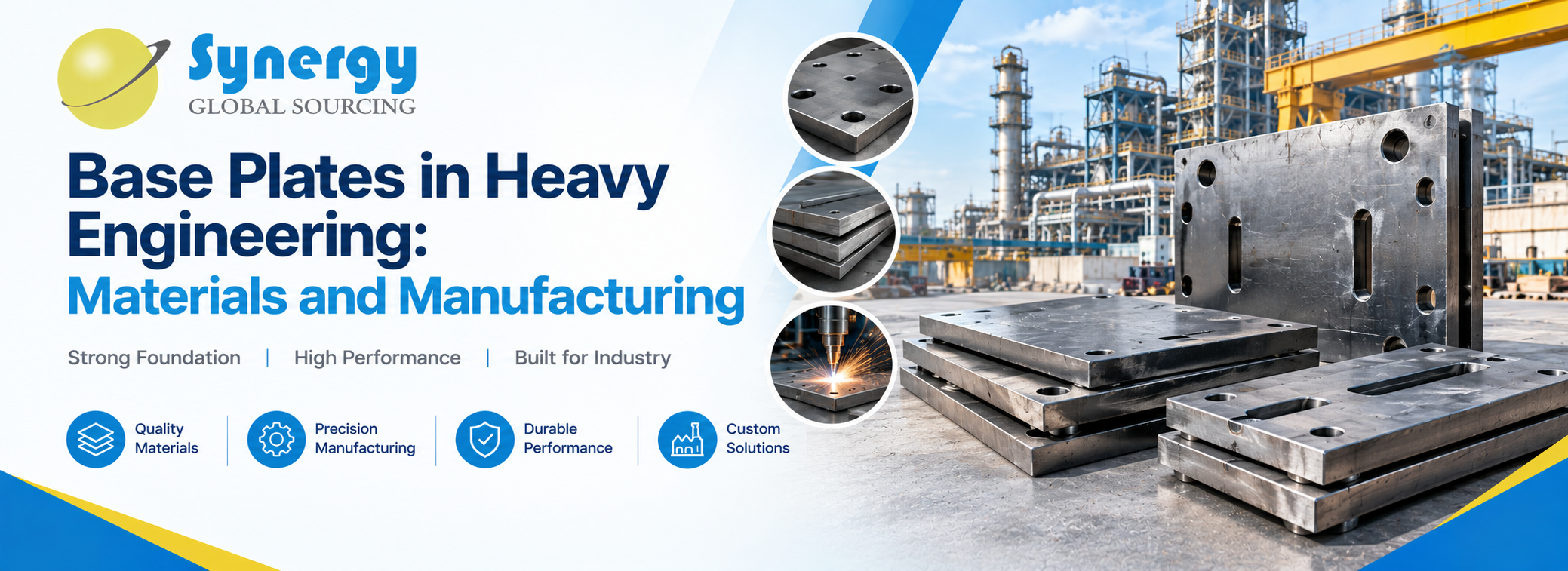
Base plates are important structural components used in heavy engineering applications to provide support, distribute loads, connect assemblies, and create stable mounting surfaces. They are commonly found in heavy machinery, industrial equipment, structural assemblies, material-handling systems, construction equipment, power infrastructure, and other engineered systems.
In demanding applications, base plates must be designed and manufactured according to specific requirements for load capacity, dimensional accuracy, material strength, rigidity, corrosion resistance, and long-term service performance.
Understanding the materials and manufacturing processes used for base plates in heavy engineering helps OEMs, engineering companies, equipment manufacturers, and industrial buyers select appropriate components for their applications.
Synergy Global Sourcing provides custom base plate manufacturing and global sourcing solutions for industrial and heavy engineering applications, supporting customers with fabricated, machined, welded, and customized metal components according to engineering drawings and technical specifications.
What Is a Base Plate?
A base plate is a flat or formed structural component used to support, mount, connect, or distribute loads between equipment and a supporting structure.
Depending on the application, a base plate may be:
- Flat
- Machined
- Welded
- Reinforced
- Fabricated
- Cast
- Forged
- Customized with holes and slots
Base plates can range from relatively small mounting plates to large, heavy-duty structural components used in industrial machinery and engineered structures.
The design depends on the equipment, loading conditions, mounting arrangement, material, dimensions, and environmental requirements.
What Are Base Plates Used for in Heavy Engineering?
Base plates perform several important functions in heavy engineering.
Load Distribution
A base plate can distribute the load from equipment or structural components across a larger supporting area.
Equipment Mounting
Machinery and equipment can be mounted to foundations or structural frames using base plates.
Structural Support
Base plates can provide a stable connection between structural members and supporting surfaces.
Alignment
Precision-machined base plates can provide controlled mounting surfaces that help maintain equipment alignment.
Vibration Management
In some machinery applications, properly designed mounting structures can help manage equipment movement and vibration.
Connection Between Components
Base plates can provide a connection point between different structural or mechanical components.
Types of Base Plates Used in Heavy Engineering
Base plates vary significantly depending on their intended use.
1. Structural Base Plates
Structural base plates are used to connect structural members to foundations or supporting structures.
They may be manufactured from carbon steel or other structural materials depending on the application.
Typical applications include:
- Industrial structures
- Equipment foundations
- Structural frames
- Support assemblies
- Heavy machinery
2. Machinery Base Plates
Machinery base plates provide mounting surfaces for industrial equipment.
They may include accurately positioned:
- Mounting holes
- Slots
- Machined surfaces
- Reinforcement sections
- Leveling features
Dimensional accuracy can be important when the base plate forms part of a precision equipment assembly.
3. Foundation Base Plates
Foundation base plates are used to connect equipment or structural components to concrete foundations or other supporting structures.
They may incorporate holes for anchor bolts and other mounting features.
4. Mounting Base Plates
Mounting base plates provide a platform for mounting motors, pumps, gearboxes, industrial equipment, and other machinery.
5. Reinforced Base Plates
Reinforced base plates include additional ribs, stiffeners, or structural elements to improve rigidity.
They may be used where higher loads or reduced deflection are required.
6. Machined Base Plates
Machined base plates are manufactured or finished using CNC machining to achieve specific dimensions, flatness, hole positions, or surface requirements.
They can be used for applications where precise equipment mounting is required.
7. Custom Fabricated Base Plates
Custom base plates are manufactured according to customer-specific engineering drawings and application requirements.
They can incorporate:
- Custom dimensions
- Holes
- Slots
- Cut-outs
- Welded reinforcements
- Machined surfaces
- Mounting features
Materials Used for Heavy Engineering Base Plates
Material selection is an important part of base plate design.
The appropriate material depends on factors such as load, structural requirements, environment, temperature, corrosion exposure, fabrication method, and cost.
Carbon Steel
Carbon steel is widely used for heavy engineering base plates because it provides a practical combination of strength, availability, weldability, and manufacturability.
It can be used for:
- Structural base plates
- Machinery mounting plates
- Foundation plates
- Equipment supports
- Fabricated assemblies
Stainless Steel
Stainless steel can be selected where corrosion resistance is a major requirement.
Applications may include:
- Outdoor equipment
- Moist environments
- Chemical-processing systems
- Food-processing equipment
- Industrial facilities
The appropriate grade should be selected according to the specific environment and mechanical requirements.
Alloy Steel
Alloy steel may be considered for applications involving higher mechanical loads or specific strength and toughness requirements.
Cast Iron
Cast iron can be used for selected machinery bases and structural components where its dimensional stability, vibration-damping characteristics, and casting capabilities are appropriate.
Aluminium
Aluminium may be considered where lower weight is important and the component’s strength requirements can be satisfied.
For heavy engineering applications, material selection should always be based on the actual design requirements rather than weight or price alone.
Manufacturing Processes for Base Plates
The manufacturing method depends on the plate’s size, geometry, material, production quantity, dimensional requirements, and application.
1. Laser Cutting
Laser cutting can be used to produce base plate profiles and mounting holes from suitable sheet or plate materials.
It can provide accurate cutting for:
- Holes
- Slots
- Cut-outs
- External profiles
- Internal openings
For thicker materials or specific production requirements, other cutting technologies may be more suitable.
2. Plasma Cutting
Plasma cutting can be used for larger and thicker metal plates where high cutting capacity is required.
It can be suitable for heavy fabricated base plates and structural components.
3. CNC Machining
CNC machining can be used to achieve controlled dimensions, flatness, holes, slots, threads, and precision mounting surfaces.
Machining may be performed after cutting or fabrication when tighter tolerances are required.
4. Drilling
Large base plates often require multiple mounting or anchor holes.
Drilling operations can produce holes according to engineering drawings and specified tolerances.
5. Welding
Welding is used when a base plate includes:
- Ribs
- Stiffeners
- Brackets
- Supports
- Frames
- Reinforcement structures
Proper welding procedures are important to control distortion and maintain dimensional requirements.
6. Forming and Bending
Certain applications may require base plates with formed or bent sections.
CNC bending or other forming processes can be used depending on material thickness and geometry.
7. Grinding and Surface Preparation
Grinding can be used to remove weld irregularities, prepare surfaces, or achieve specific finishing requirements.
8. Surface Finishing
Depending on the application, base plates may require:
- Painting
- Powder coating
- Galvanizing
- Plating
- Protective coatings
- Machined finishing
- Surface treatment
The appropriate finish depends on the operating environment and corrosion requirements.
Manufacturing Process for Custom Base Plates
A typical custom base plate manufacturing process can include several stages.
Step 1: Engineering Drawing Review
The manufacturing partner reviews:
- Dimensions
- Material
- Thickness
- Hole patterns
- Tolerances
- Flatness
- Weld requirements
- Surface finish
- Quantity
Step 2: Manufacturing Process Selection
The appropriate combination of cutting, machining, drilling, welding, and finishing processes is selected.
Step 3: Material Procurement
The required material and thickness are sourced according to the approved specification.
Step 4: Cutting
The plate is cut according to the required external profile and internal features.
Step 5: Machining and Drilling
Precision features such as holes, slots, threads, and mounting surfaces are produced where required.
Step 6: Fabrication and Welding
Stiffeners, ribs, supports, or other components are welded to the base plate if specified.
Step 7: Inspection
Critical dimensions, hole positions, flatness, weld quality, and other requirements are checked.
Step 8: Surface Finishing
The specified coating or surface treatment is applied.
Step 9: Final Inspection and Packaging
The finished base plate is inspected and packaged for delivery.
Key Design Considerations for Heavy Engineering Base Plates
Base plate design should account for the actual operating conditions of the equipment.
Load Capacity
The base plate should be capable of supporting the intended static and dynamic loads.
Plate Thickness
Material thickness affects stiffness, weight, strength, and manufacturing requirements.
Flatness
Flatness can be particularly important when machinery must be mounted accurately.
Hole Position
Incorrect hole positioning can cause installation and alignment problems.
Stiffeners
Large or heavily loaded plates may require ribs or stiffeners to improve rigidity.
Weld Distortion
Welding can introduce thermal distortion. Fabrication planning and appropriate welding procedures can help control dimensional changes.
Corrosion Protection
Outdoor or corrosive environments may require appropriate materials or surface protection.
Importance of Dimensional Accuracy
Dimensional accuracy is particularly important when a base plate acts as a mounting interface.
Critical features may include:
- Overall dimensions
- Hole diameter
- Hole location
- Flatness
- Parallelism
- Surface finish
- Mounting height
- Alignment features
The required tolerance should be determined according to the engineering function of the component.
Base Plates for Heavy Machinery
Heavy machinery may require large and structurally robust base plates to support equipment and transfer loads to a foundation or supporting structure.
Applications can include:
- Industrial machinery
- Pumps
- Motors
- Gearboxes
- Compressors
- Material-handling equipment
- Heavy processing equipment
- Industrial production systems
Base plate design should account for equipment weight, operating loads, mounting arrangement, vibration, and foundation conditions.
Base Plates for Industrial Equipment
Industrial equipment frequently uses base plates as mounting interfaces.
A custom industrial base plate can be designed with specific:
- Mounting holes
- Anchor locations
- Machined surfaces
- Equipment interfaces
- Reinforcement ribs
- Leveling provisions
This enables the base plate to match the equipment and installation environment.
Base Plates and Vibration
Some machinery applications generate significant vibration.
Motors, pumps, compressors, gearboxes, and other rotating equipment may transmit dynamic forces into their supporting structures.
Base plate design may therefore need to consider:
- Equipment weight
- Operating speed
- Dynamic loads
- Mounting arrangement
- Structural rigidity
- Foundation conditions
For vibration-sensitive applications, the base plate should be engineered as part of the overall equipment mounting system.
Quality Control for Base Plates
Quality inspection helps verify that finished base plates comply with engineering requirements.
Typical inspection activities can include:
- Material verification
- Plate thickness measurement
- Dimensional inspection
- Hole-position inspection
- Hole-diameter measurement
- Flatness checks
- Weld inspection
- Surface inspection
- Coating inspection
- Final visual inspection
For precision components, additional measurement methods may be required based on the specified tolerances.
Benefits of Custom Base Plate Manufacturing
Custom manufacturing provides several practical advantages for OEMs and industrial equipment manufacturers.
Application-Specific Dimensions
The plate can be manufactured according to the exact equipment and foundation requirements.
Flexible Mounting Features
Holes, slots, cut-outs, and other features can be positioned according to the engineering drawing.
Material Selection
Customers can specify a material appropriate for the required strength and operating environment.
Integrated Fabrication
Base plates can incorporate welded stiffeners, brackets, supports, and other structures.
Production Flexibility
Manufacturing can support prototypes, low-volume production, and recurring orders depending on the process and component design.
Cost Factors for Heavy Engineering Base Plates
The cost of a base plate depends on several variables.
Important factors include:
- Material grade
- Plate thickness
- Overall dimensions
- Component weight
- Cutting method
- Number of holes
- Machining requirements
- Welding
- Stiffeners
- Surface treatment
- Inspection
- Packaging
- Transportation
For heavy and large components, logistics can also become an important part of the overall sourcing cost.
Design optimization can help identify opportunities to reduce unnecessary material, machining, welding, or fabrication operations while maintaining required performance.
Why Source Base Plates from India?
India has a broad industrial manufacturing ecosystem capable of supporting metal cutting, fabrication, machining, welding, structural manufacturing, and surface finishing.
For international buyers, sourcing base plates from India can provide access to manufacturers with capabilities for both customized and recurring production.
However, supplier selection should consider:
- Manufacturing capability
- Quality systems
- Engineering support
- Production capacity
- Material sourcing
- Inspection capability
- Documentation
- Packaging
- Logistics
These factors are important when sourcing components for demanding heavy engineering applications.
Global Base Plate Sourcing with Synergy Global Sourcing
Synergy Global Sourcing provides custom manufacturing and sourcing solutions for base plates and other industrial metal components.
Our capabilities can support requirements involving:
- Heavy engineering base plates
- Machinery base plates
- Structural base plates
- Foundation plates
- Mounting plates
- Reinforced base plates
- Machined base plates
- Welded base plate assemblies
- Custom fabricated plates
Projects can be developed according to engineering drawings, CAD files, material specifications, tolerances, quantities, surface treatment requirements, inspection criteria, and delivery schedules.
For international customers, sourcing support can include quality coordination, packaging, documentation, and shipment planning.
How Synergy Global Sourcing Supports Base Plate Manufacturing
A structured sourcing process can help manage the manufacturing requirements of large and customized base plates.
The process may include:
Drawing Review → Material Selection → Process Planning → Cutting → Machining/Drilling → Welding → Inspection → Finishing → Final Inspection → Packaging → Shipment
This approach helps coordinate different manufacturing stages while keeping the customer’s technical requirements central to the project.
How to Choose a Base Plate Manufacturer
When selecting a base plate manufacturer, industrial buyers should evaluate several factors.
Technical Capability
Can the manufacturer handle the required plate size, thickness, material, and manufacturing processes?
Precision Capability
Can the supplier achieve the required dimensional tolerances, hole positions, flatness, and machining requirements?
Fabrication Capability
Can the supplier manufacture welded reinforcements, ribs, brackets, and other integrated structures?
Quality Control
Does the supplier have suitable inspection procedures and documentation?
Production Capacity
Can the supplier meet the required quantity and delivery schedule?
Packaging and Logistics
For international projects, can the supplier safely package large and heavy components and coordinate shipment requirements?
Conclusion
Base plates are fundamental components in heavy engineering systems where equipment, machinery, and structural assemblies require stable support and reliable load transfer.
The selection of material, thickness, manufacturing process, reinforcement design, dimensional tolerances, surface finish, and inspection requirements should be based on the component’s specific application.
For OEMs, equipment manufacturers, engineering companies, and global industrial buyers, working with a capable manufacturing and sourcing partner can simplify the production of customized base plates.
Synergy Global Sourcing provides custom base plate manufacturing and global sourcing solutions covering cutting, machining, drilling, welding, fabrication, finishing, inspection, packaging, and international supply coordination.
Whether you require heavy engineering base plates, machinery mounting plates, structural base plates, foundation plates, reinforced plates, or custom fabricated base plate assemblies, Synergy Global Sourcing can support your requirements from technical evaluation through production and delivery.
Share your engineering drawings, CAD files, material specifications, dimensions, required quantity, tolerances, and application details with Synergy Global Sourcing to discuss your custom base plate manufacturing requirements.
Read more: Custom Metal Clamps for Industrial Applications
Frequently Asked Questions
What is a base plate in heavy engineering?
A base plate is a structural or mounting component used to support equipment, distribute loads, connect assemblies, and provide a stable mounting surface.
Which materials are used for heavy engineering base plates?
Carbon steel is commonly used, while stainless steel, alloy steel, cast iron, and aluminium may be selected for specific applications depending on strength, corrosion resistance, weight, and operating conditions.
How are heavy engineering base plates manufactured?
Base plates can be manufactured using processes such as laser cutting, plasma cutting, drilling, CNC machining, welding, grinding, forming, and surface finishing.
Can base plates be manufactured according to custom drawings?
Yes. Custom base plates can be manufactured according to 2D engineering drawings, 3D CAD models, material specifications, dimensions, tolerances, hole patterns, flatness requirements, and surface-finish specifications.
What industries use heavy engineering base plates?
Base plates are used in heavy machinery, industrial equipment, construction equipment, material handling, power infrastructure, manufacturing systems, structural assemblies, and other engineering applications.
Why is flatness important for machinery base plates?
Flatness can be important because the base plate may provide the mounting surface for equipment. Excessive deviation can affect installation, alignment, and equipment positioning.
Can base plates include welded stiffeners?
Yes. Large or heavily loaded base plates can be fabricated with welded ribs, stiffeners, brackets, supports, and other structural features according to engineering requirements.
Can Synergy Global Sourcing supply custom base plates internationally?
Yes. Synergy Global Sourcing provides custom base plate manufacturing and global sourcing support for industrial and heavy engineering customers based on technical specifications, quantities, quality requirements, and delivery needs.
How can I request a quotation for a custom base plate?
Provide the engineering drawing or CAD model along with material grade, thickness, dimensions, quantity, tolerances, machining requirements, surface finish, inspection requirements, and delivery location. These details help determine the appropriate manufacturing process and quotation.


