
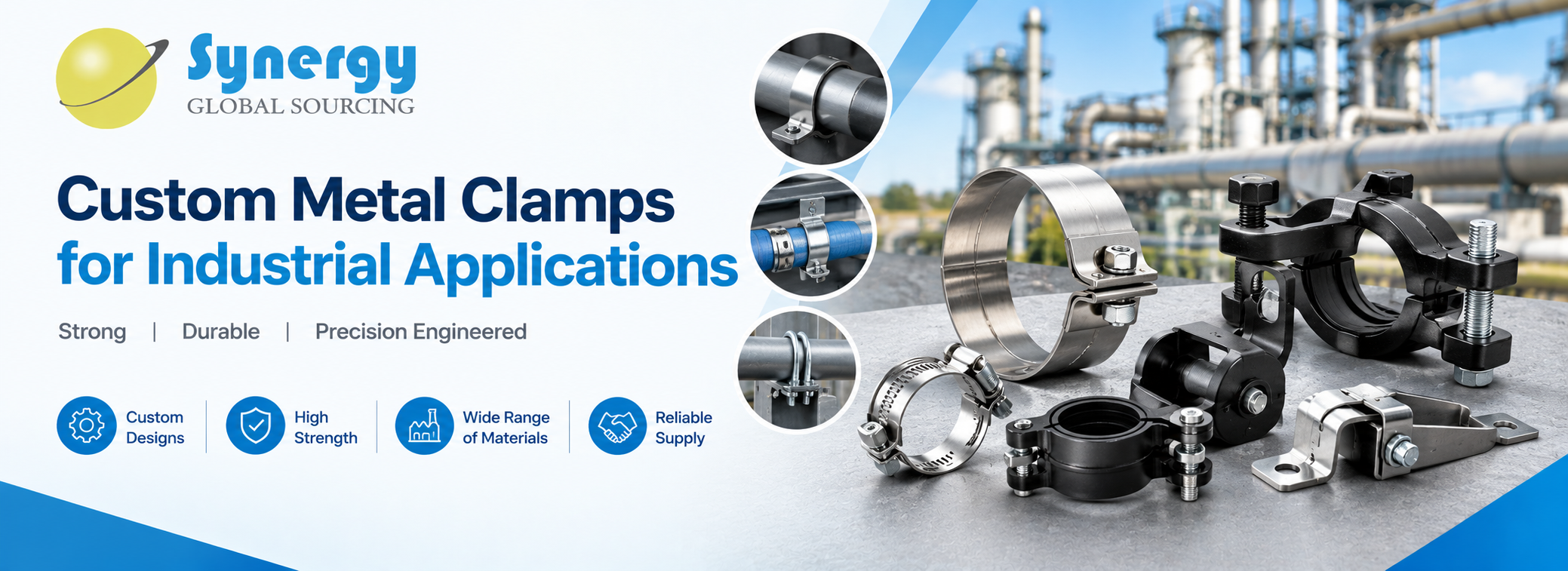
Metal clamps are essential components used across industrial systems to secure, support, position, hold, and connect pipes, tubes, cables, hoses, machinery components, and structural assemblies. Depending on the application, industrial clamps may need to withstand vibration, mechanical loads, temperature variations, moisture, corrosion, pressure, and continuous operating conditions.
Custom metal clamps for industrial applications provide manufacturers and engineering companies with a practical solution when standard clamps cannot meet specific dimensional, structural, mounting, or environmental requirements.
Synergy Global Sourcing provides custom metal clamp manufacturing and global sourcing solutions for industrial customers requiring application-specific components. From sheet metal clamps and pipe clamps to heavy-duty fabricated clamps and OEM components, manufacturing can be developed according to customer drawings, materials, dimensions, tolerances, quantities, and finishing requirements.
What Are Custom Metal Clamps?
Custom metal clamps are specially manufactured components designed to hold, secure, guide, position, or support another component or assembly.
Unlike standard off-the-shelf clamps, custom clamps can be developed around the exact requirements of a particular application.
A custom metal clamp may be designed according to:
- Component dimensions
- Pipe or tube diameter
- Mounting arrangement
- Required load capacity
- Material requirements
- Operating temperature
- Vibration conditions
- Corrosion exposure
- Installation space
- Surface finishing
- Production volume
Custom clamps can be manufactured using different metal fabrication and forming processes depending on their design and intended use.
Why Are Metal Clamps Important in Industrial Applications?
Industrial systems frequently contain components that need to remain securely positioned during operation.
A properly designed clamp can help:
Secure Components
Clamps can hold pipes, tubes, hoses, cables, and other components in their intended position.
Reduce Unwanted Movement
Properly designed clamps can help control movement caused by vibration or operational forces.
Support Assemblies
Clamps can provide structural support for components installed on frames, machinery, walls, panels, or other structures.
Improve Installation
Custom dimensions and mounting features can make installation easier when space or component geometry is restricted.
Protect Components
The right clamp design and material can help prevent unnecessary movement, contact, or mechanical stress.
Types of Custom Metal Clamps
Different industrial applications require different clamp designs.
1. Pipe Clamps
Pipe clamps are designed to secure pipes to structures or support systems.
They can be customized according to:
- Pipe diameter
- Pipe material
- Mounting arrangement
- Load requirements
- Environmental conditions
- Required spacing
Pipe clamps are used across industrial piping, mechanical systems, infrastructure, and equipment.
2. Tube Clamps
Tube clamps are used to secure tubing and tubular components.
Custom tube clamps can be manufactured for specific diameters, wall thicknesses, mounting points, and installation conditions.
3. Hose Clamps
Hose clamps are used to secure hoses around connections or fittings.
Industrial hose clamp requirements may vary depending on hose diameter, pressure, temperature, vibration, and environmental exposure.
4. Cable Clamps
Cable clamps help organize and secure cables, wiring, and electrical lines.
They can be manufactured with specific mounting holes, slots, profiles, and protective features.
5. U-Bolts and U-Shaped Clamps
U-shaped clamps can be used to secure pipes, tubes, rods, shafts, and other cylindrical components.
They are available in different dimensions and materials depending on the application.
6. Heavy-Duty Metal Clamps
Heavy-duty clamps are designed for applications involving higher mechanical loads or demanding operating conditions.
They may be manufactured using thicker materials, reinforced structures, or specialized geometries.
7. Mounting Clamps
Mounting clamps are used to secure components to frames, structures, panels, equipment, or machinery.
They can incorporate:
- Mounting holes
- Slots
- Threaded features
- Brackets
- Reinforcement sections
8. Custom Fabricated Clamps
Custom fabricated clamps are developed specifically for an OEM or industrial application.
They may combine multiple bends, welded sections, mounting features, and custom profiles into a single component or assembly.
Materials Used for Custom Metal Clamps
Material selection depends on the mechanical, environmental, and dimensional requirements of the application.
Carbon Steel
Carbon steel is commonly used for industrial clamps because it provides a combination of strength, availability, and manufacturability.
It may be suitable for:
- Structural clamps
- Pipe supports
- Machinery clamps
- Heavy-duty applications
- General industrial assemblies
Stainless Steel
Stainless steel can be selected when corrosion resistance is an important requirement.
Applications may include:
- Outdoor equipment
- Industrial piping
- Moist environments
- Chemical-processing environments
- Food-processing equipment
- Marine-related applications
The appropriate stainless steel grade depends on the operating environment and technical requirements.
Aluminium
Aluminium clamps may be considered when low weight and corrosion resistance are important.
They can be suitable for applications where the required mechanical performance aligns with aluminium’s properties.
Alloy Steel
Alloy steel may be considered for applications involving higher mechanical loads or specific strength requirements.
Material selection should be based on the engineering requirements of the finished component.
Manufacturing Processes for Custom Metal Clamps
The manufacturing process depends on the clamp’s geometry, material, production volume, and required tolerances.
Laser Cutting
Laser cutting can produce accurate profiles, holes, and slots from sheet metal and plate.
It is suitable for custom clamp components requiring precise dimensions.
CNC Bending
CNC bending is commonly used to form sheet metal clamps into specific shapes.
It can produce:
- U-shaped clamps
- Angle clamps
- Mounting clamps
- Support clamps
- Custom bent profiles
Stamping
Metal stamping can be suitable for high-volume production of repeatable clamp designs.
Stamping can provide efficient production when component geometry and production volumes justify dedicated tooling.
Wire Forming
Wire forming can be used for clamps made from wire or rod material.
The process can create specific shapes according to the component design.
Welding
Some heavy-duty clamps may require multiple fabricated pieces to be welded together.
Welding can be used to produce reinforced clamps and complex clamp assemblies.
CNC Machining
Machining can be used when custom clamps require precise holes, threads, slots, surfaces, or other controlled features.
Surface Finishing
Depending on the application, clamps may require:
- Powder coating
- Painting
- Galvanizing
- Plating
- Passivation
- Protective coatings
- Deburring
The appropriate finish depends on the material and environmental requirements.
Industrial Applications of Custom Metal Clamps
Custom metal clamps are used in numerous industrial sectors.
Industrial Machinery
Machinery manufacturers use clamps to secure pipes, cables, tubes, hoses, guards, and other components.
Custom designs can accommodate specific machine layouts and mounting requirements.
Construction Equipment
Heavy machinery can require clamps for hydraulic lines, hoses, cables, tubes, and structural components.
Clamp designs may need to account for vibration, impact, and demanding working environments.
Agricultural Equipment
Agricultural machinery may use custom clamps for:
- Hydraulic hoses
- Pipes
- Tubes
- Cables
- Equipment assemblies
- Structural components
Mining Equipment
Mining machinery operates in environments involving dust, vibration, impact, and abrasive materials.
Heavy-duty clamps may be used to secure hydraulic, pneumatic, electrical, and structural components.
Energy and Power Equipment
Clamps can be used to support and organize cables, pipes, tubes, and equipment components in power-generation and energy-related applications.
HVAC Systems
Metal clamps can secure pipes, ducts, tubes, and other HVAC components.
Electrical Equipment
Cable clamps and mounting clamps are commonly used to organize and secure wiring and electrical components.
Material Handling Equipment
Conveyors and material-handling systems may require custom clamps for cables, pipes, sensors, protective structures, and other components.
Industrial Automation
Automated machinery can use clamps for cable management, pneumatic lines, sensors, tubes, and machine components.
Custom Metal Clamps for OEM Applications
OEMs often require clamps designed specifically around their equipment.
A custom OEM clamp can be manufactured according to:
- Engineering drawings
- CAD models
- Material specifications
- Dimensional tolerances
- Load requirements
- Mounting requirements
- Surface finish
- Production volume
- Quality standards
The manufacturing process can be developed around the equipment’s actual installation and operating conditions.
Design Considerations for Custom Industrial Clamps
Several factors should be considered before manufacturing a custom metal clamp.
Component Diameter
For pipe, tube, hose, or cable clamps, accurate dimensional information is important for achieving the required fit.
Load Requirements
The clamp should be designed to withstand the expected mechanical loads without unwanted deformation or failure.
Vibration
Applications involving machinery or moving equipment may require clamp designs that account for continuous vibration.
Temperature
High- or low-temperature environments can affect material and finishing choices.
Corrosion
Outdoor, marine, chemical, or humid environments may require corrosion-resistant materials or protective finishes.
Mounting Configuration
The clamp may need specific holes, slots, threads, brackets, or other features for installation.
Installation and Maintenance
A good clamp design should consider how the component will be installed, inspected, adjusted, and replaced during maintenance.
Custom Metal Clamps for High-Vibration Applications
Vibration is a major consideration in many industrial environments.
Machinery, engines, pumps, compressors, construction equipment, and other systems can generate continuous mechanical vibration.
Clamp design may therefore consider:
- Material thickness
- Clamp geometry
- Mounting method
- Contact surfaces
- Fastener arrangement
- Component movement
- Environmental conditions
Where required, suitable isolation or protective elements may also be incorporated into the overall assembly design.
Corrosion Protection for Industrial Metal Clamps
Clamps used outdoors or in corrosive environments may require additional protection.
Possible approaches include:
- Stainless steel construction
- Galvanizing
- Powder coating
- Painting
- Plating
- Passivation
- Protective coatings
The appropriate solution depends on the base material and exposure conditions.
Custom Clamp Manufacturing Process
A typical custom clamp manufacturing workflow can include:
Step 1: Requirement Review
The manufacturer reviews drawings, dimensions, material requirements, application conditions, and quantities.
Step 2: Design and Manufacturing Evaluation
The component is assessed for manufacturability, tolerances, tooling, and production requirements.
Step 3: Material Selection
The required material and thickness are identified according to the application.
Step 4: Prototype or Sample Production
A sample may be produced for dimensional and functional evaluation.
Step 5: Inspection
The component is inspected according to agreed quality requirements.
Step 6: Production
After approval, the component enters regular production.
Step 7: Finishing
The required surface treatment or coating is applied.
Step 8: Final Inspection and Packaging
Finished clamps are inspected, packaged, and prepared for shipment.
Quality Control for Custom Metal Clamps
Quality control is important because clamp dimensions and mounting features can directly affect installation and component security.
Quality checks may include:
- Material verification
- Dimensional inspection
- Thickness measurement
- Hole and slot inspection
- Bend-angle inspection
- Thread inspection
- Weld inspection
- Surface-finish inspection
- Visual inspection
- Final packaging inspection
Inspection criteria should be defined according to the engineering specification and application requirements.
Benefits of Custom Metal Clamps
Compared with generic components, custom clamps can provide application-specific advantages.
Exact Fit
The clamp can be designed according to the actual dimensions of the component.
Application-Specific Design
Mounting holes, slots, bends, and profiles can be customized.
Improved Installation
Custom geometry can simplify installation where standard clamps do not fit.
Material Flexibility
Customers can specify suitable materials based on environmental and mechanical requirements.
Production Scalability
Custom clamps can be produced for prototypes, small batches, and recurring production, depending on the selected manufacturing process.
Integration with OEM Designs
Custom clamps can be designed as part of a larger equipment assembly.
Cost Factors for Custom Metal Clamps
The price of a custom metal clamp depends on several factors.
Important considerations include:
- Material
- Material thickness
- Clamp dimensions
- Component geometry
- Number of bends
- Cutting requirements
- Tooling
- Production volume
- Welding
- Machining
- Surface finishing
- Inspection
- Packaging
- Logistics
For high-volume applications, stamping or dedicated tooling may provide manufacturing efficiencies when appropriate.
For lower volumes or highly customized designs, flexible fabrication processes may be more suitable.
Why Source Custom Metal Clamps from India?
India has a broad industrial manufacturing ecosystem covering sheet metal fabrication, CNC machining, stamping, forming, welding, casting, finishing, and assembly.
For international buyers, sourcing custom metal clamps from India can provide access to diverse manufacturing capabilities.
However, the right supplier should be selected based on technical capability, quality control, production capacity, documentation, communication, and total supply-chain requirements.
Global Custom Metal Clamp Sourcing with Synergy Global Sourcing
Synergy Global Sourcing provides custom metal clamp manufacturing and sourcing solutions for industrial and OEM customers.
Our sourcing capabilities can support:
- Pipe clamps
- Tube clamps
- Hose clamps
- Cable clamps
- U-shaped clamps
- Heavy-duty clamps
- Mounting clamps
- Structural clamps
- Custom fabricated clamps
- OEM clamp assemblies
Components can be developed according to customer drawings, CAD files, material requirements, dimensional tolerances, quantities, finishing specifications, and delivery requirements.
For international customers, sourcing support can also include quality coordination, packaging, documentation, and shipment planning.
How Synergy Global Sourcing Supports Custom Clamp Projects
A structured sourcing approach can help customers manage custom component production from initial technical requirements through delivery.
The process may include:
Requirement Review → Manufacturing Evaluation → Prototype → Quality Inspection → Production → Finishing → Final Inspection → Packaging → Shipment
This approach provides a clear framework for managing customized industrial clamp requirements.
How to Choose a Custom Metal Clamp Manufacturer
When evaluating a supplier, industrial buyers should consider:
Manufacturing Capability
Can the supplier manufacture the required clamp geometry and material?
Engineering Support
Can the supplier understand drawings, CAD files, tolerances, and application requirements?
Quality Control
Can the supplier perform the required inspections and provide appropriate documentation?
Production Capacity
Can the manufacturing process support your required quantities and delivery schedule?
Customization
Can the supplier modify dimensions, mounting features, materials, and finishes according to your application?
Global Supply Support
For international buyers, can the supplier coordinate packaging, documentation, and logistics?
Conclusion
Custom metal clamps are important components in industrial systems where pipes, tubes, hoses, cables, and mechanical components need secure and reliable support.
The right clamp depends on material, dimensions, load requirements, vibration, temperature, corrosion exposure, mounting configuration, and manufacturing process.
Working with an experienced custom manufacturing and sourcing partner can help industrial companies develop clamps that meet their specific technical requirements.
Synergy Global Sourcing provides custom metal clamp manufacturing and global sourcing solutions for industrial and OEM applications, supporting processes such as laser cutting, CNC bending, stamping, forming, welding, machining, finishing, inspection, and assembly.
Whether you require custom pipe clamps, tube clamps, cable clamps, heavy-duty metal clamps, mounting clamps, or OEM-specific clamp assemblies, Synergy Global Sourcing can support the sourcing process from technical evaluation through production and global delivery.
Share your drawings, CAD files, material specifications, required quantities, and application details with Synergy Global Sourcing to discuss your custom metal clamp requirements.
Read More: Metal Brackets Manufacturer in India: Types and Applications
Frequently Asked Questions
What are custom metal clamps used for?
Custom metal clamps are used to secure, support, position, or organize pipes, tubes, hoses, cables, wires, machinery components, and structural assemblies according to application-specific requirements.
What types of custom metal clamps can be manufactured?
Custom manufacturers can produce pipe clamps, tube clamps, hose clamps, cable clamps, U-shaped clamps, mounting clamps, heavy-duty clamps, structural clamps, and application-specific fabricated clamps.
Which materials are used for industrial metal clamps?
Carbon steel, stainless steel, aluminium, and selected alloy steels can be used depending on the mechanical requirements, corrosion exposure, temperature, weight, and operating environment.
Can custom clamps be manufactured according to CAD drawings?
Yes. Custom industrial clamps can be manufactured according to 2D engineering drawings, 3D CAD models, technical specifications, dimensions, tolerances, and finishing requirements.
Are custom metal clamps suitable for high-vibration applications?
They can be designed for applications involving vibration, but the appropriate clamp geometry, material, mounting arrangement, and overall assembly should be determined according to the specific operating conditions.
Can metal clamps be used outdoors?
Yes. Outdoor clamp applications may require suitable corrosion-resistant materials or protective surface treatments such as galvanizing, powder coating, painting, plating, or other specified finishes.
Can Synergy Global Sourcing manufacture custom industrial clamps?
Yes. Synergy Global Sourcing provides custom metal clamp manufacturing and sourcing support for industrial and OEM customers based on their drawings, materials, dimensions, quantities, quality requirements, and application specifications.
How do I request a quote for custom metal clamps?
Provide the engineering drawing or CAD file along with the required material, dimensions, quantity, tolerances, surface finish, application details, and delivery location. These details help determine the appropriate manufacturing process and quotation.


